Metal Temperatures, EGTs, and “Conservative Tuning”
Just How Hot Are Your EGTs When the Headers Glow?
The answer is “it depends”. But what is not up for debate is the science behind glowing metal. At the very basis of this discussion, we must first acknowledge that metals like stainless steel don’t glow unless they’re heated by something warmer than them. In the case of exhaust headers, that heat comes from the spent combustion gases whose temperature varies based upon load, relative AFR, spark timing, cam timing, and a couple other things.
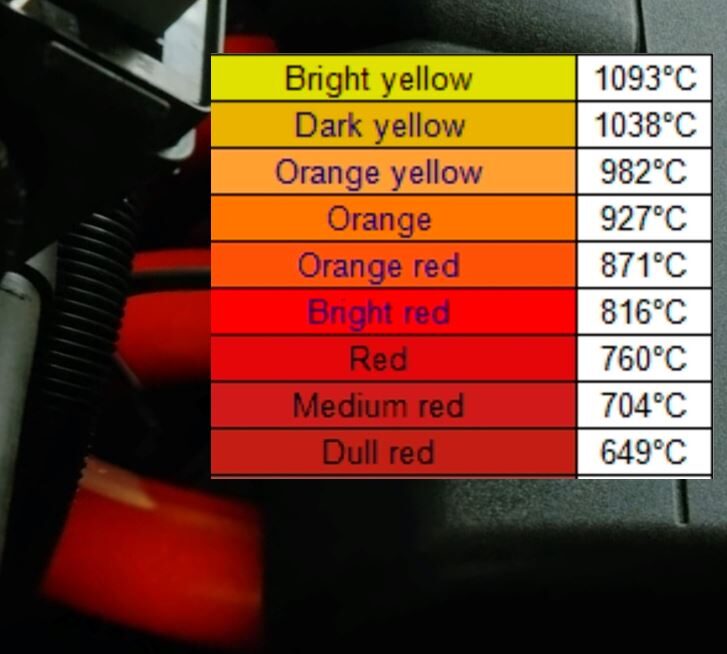
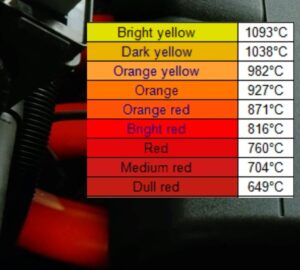
Let’s start with finding out what metal skin temperature correlates with colors we might see. A quick search dug up THIS SITE with a handy chart for stainless steel alloys along with more information on the base metals.
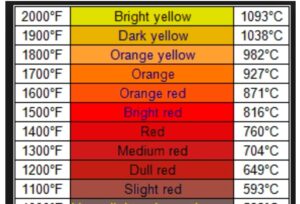
Even more info HERE. Is this guide between metal temp and observed color absolutely perfect? NO. Other factors can play in here like surface finish, prior heat cycles, aging, available oxygen, and alloy batch. (Thanks to Dr. Lesko for chiming in here!) But it gives a general correlation and some estimates from which we can begin to work.
For reference, Kook’s Headers are made from 16 gauge 304 Stainless according to THEIR WEBSITE. This correlates with our reference material property chart at right.
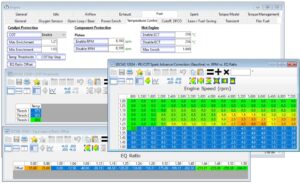
The point here is that if we can see a significant color change in the outer skin of the exhaust, logic says that the inner skin is likely warmer, and the gases heating that inner skin are warmer yet. OEMs estimate this exhaust gas temp using a model based upon thermocouple data taken during the development phase before cars reach the showroom. Engineers spend countless hours making sure this model is close enough that they can use it to know when they must do something to keep EGTs below the temperature thresholds that typically damage the catalyst, around 950-1000° C. They’ll then employ “Catalyst Overtemp Protection” that kicks in at some (estimated) EGT threshold to help avoid damaging the expensive catalysts that must be warrantied for the Full Useful Life (FUL) in terms of emissions requirements. Understanding the link between AFR and flame speed, they also adjust (add) timing when running richer in the PE/COT Correction table.
For Federal Tier 2 light duty vehicles starting in 2004, FUL was at least 100,000 miles. Current Tier 3 standard go to 150,000 miles. OEMs don’t want to have to buy people new catalysts in this time due to preventable temperature related failures.
If we are doing our own aftermarket calibration, we can choose whatever combination for AFR and spark we deem appropriate for our goals. There still exists a tradeoff between power, AFR, spark, and EGT where some combinations of AFR and spark might make good power, but with elevated EGTs. Generally speaking, running richer with more spark advance lowers these temperatures just like the OEM COT strategy, and might even stay close on total power delivered. The exact balance here will be unique to the hardware combination and fuel spec. Whatever we choose will determine the EGTs that get passed downstream to the catalyst on street cars. Our objective should be to keep those temperatures reasonably safe while making good power.
OK, so that’s skin temperature. How do we find EGT if we don’t have thermocouples in the vehicle because it just isn’t practical on a typical install and dyno tune? Let’s fire up the AI and let bring in the appropriate equations to solve for heat transfer just like we did in Dr. Berg’s class back at Kettering in the 90’s. This science hasn’t changed, and AI is really good at doing this sort of math when given a decent prompt. Let’s assume this is a garden variety mid-500’s HP LSx street car running 12.3:1 AFR:
What temperature would the exhaust gases need to be to make the outside skin temperature of a 16 gauge 304 stainless exhaust manifold glow orange-red (approximately 816 C)? The hood is open, so assume air temperature in the engine bay surrounding the exhaust manifold is 200 degrees F 2000cfm cooling airflow. The engine is making approximately 580hp, so this would be 58lb/min or airflow. Air-fuel ratio is 12.3:1, making to total exhaust flow 62.7 lb/min.
If you copy that prompt into ChatGPT, it will faithfully execute calculations for both radiant and convective heat losses to balance the equations and find the require input EGT. Mine thought for all of 24 seconds before answering. Because there are still a few variables, it gives us a range of 1250-1400° C. It had to make some assumptions about convection rates and surface area, which is why I estimated low-ish on those. If the cooling airflow or surface area is higher, it actually makes the situation worse since the required input temperature required to get that skin temperature would be even higher when fighting more outside cooling.
For a real open-hood engine bay with strong fan airflow, I’d use:
approx 1250–
or:
2280–2550∘F
That is extremely hot for a gasoline turbo/exhaust manifold. If the manifold skin is truly 816°C, the gas is probably well above normal full-load safe EGT unless there is severe ignition retard, afterburning in the manifold, lean operation, or unusually poor internal heat transfer.
The robot also seems to have its own assessment of our estimated temperatures. Its words, not mine there. Play around with different surface temps in the prompt and you can get a feel for the relationship between EGT and manifold color. The reality is that we’re probably not 1400 C in this example, but we’re probably still well over where GM would have left it, especially for a naturally aspirated engine that isn’t fighting turbine backpressure. Again, GM would have stepped in pretty swiftly around 900 C.
So where do we go from here?
As the calibrator, you have several choices. If the engine really is at the knock limit, you can’t add more timing. That narrows it down to adding fueling. As we add fuel, it slows combustion and actually wants more timing while the knock limit usually moves slightly further away. If it wasn’t knocking yet, adding more timing seems obvious other than “staying conservative”. Modern knock control is pretty good, so we’re able to run closer to the limits sometimes as long as we have faith that the sensor will catch it and make the right adjustment in time. Admittedly, that can be a big “IF” with modified engines.
But this explains why GM might be running 26° of spark on the LT4 at WOT. They can only get away with that when all the extra fuel is also present. It depends on the specific combustion system how this tradeoff pans out. Your number might not be 26°, but going artificially low does risk having incomplete combustion in the cylinders and leaving more of that energy in the exhaust gases on the way out. YOU have to decide what’s appropriate for each combination while understanding these tradeoffs.
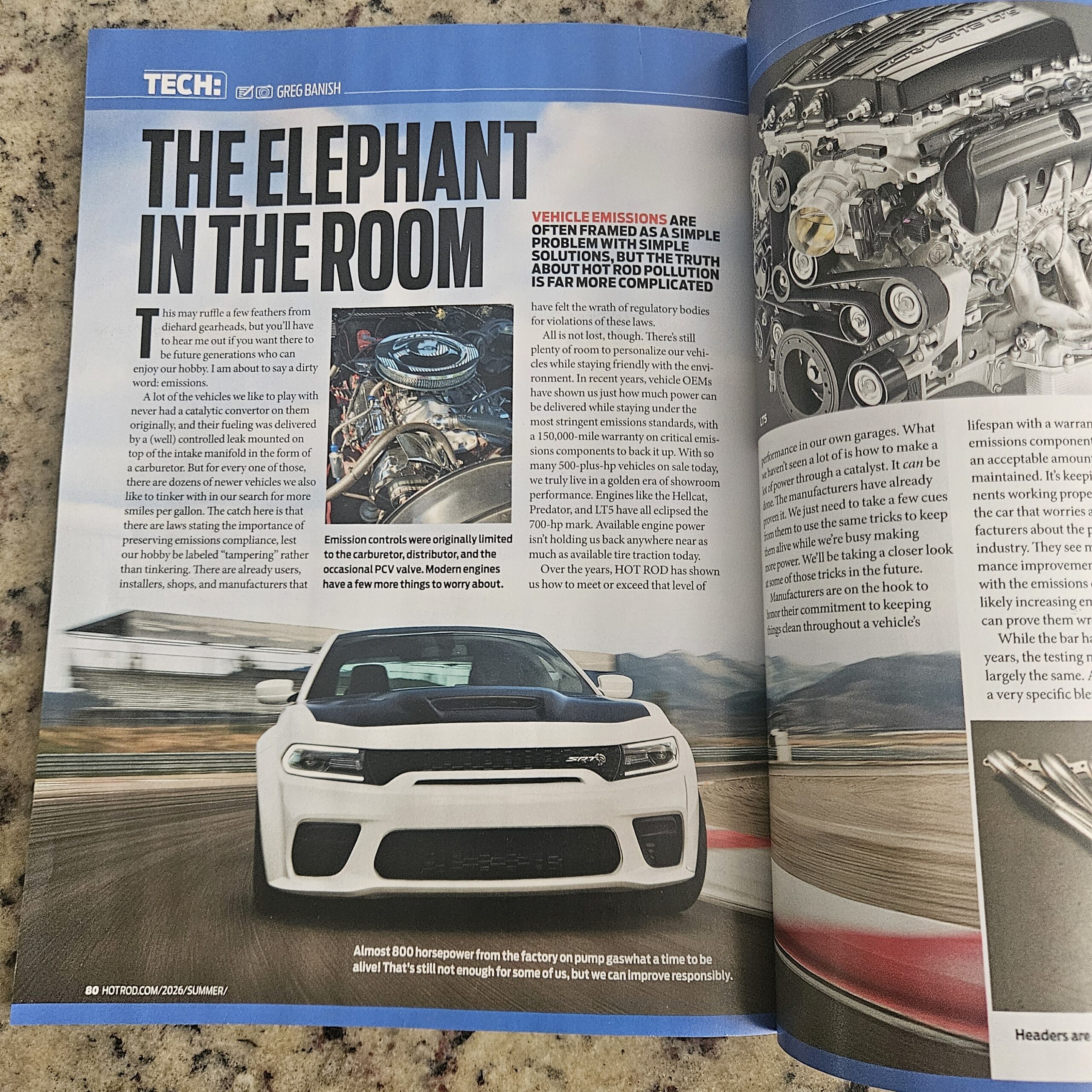





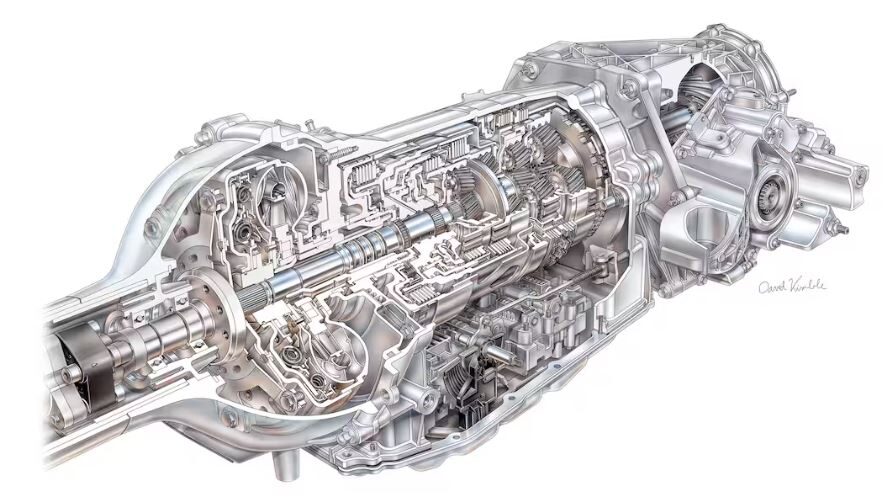
 In a recent article written for Hot Rod Magazine, I dove into the finer points of how modern 6/8/10 speed automatic transmissions work so well to keep the engine right in the sweet spot for acceleration. They often do this with the torque convertor locked most of the time. This means we only care about the slip RPM (K-Factor) right off the line, where traction is often a challenge anyway. The same actually holds true for when we’re looking for peak fuel economy, but who can think of that when we have drag races to win? With more ratios to choose from, the game has changed.
![20250604_181018[1]](https://calibratedsuccess.com/wp-content/uploads/2025/06/20250604_1810181-scaled-2560x2560.jpg)